Landscape & hardscape lighting
Landscape lighting, wired to last.
Wyatt Electric designs and installs low-voltage landscape and hardscape lighting for homes across Harford County, Baltimore County and Baltimore City: path lights, uplit trees, step and wall lights built into patios and retaining walls, and the transformer and circuit that run it all. Sized for the run, buried to code, and switched from a timer, a keypad or your phone.
- ★5.0 · 12 Google reviews
- 4 Master Electricians on staff
- Licensed & insured
- Veteran owned
- 5.0 stars12 Google reviews
- Since 198640 years in business
- 4 MastersMaster Electricians
- Veteran ownedLicensed & insured
- ESGR 2010Above & Beyond Award
The short answer
Do you need an electrician for landscape lighting?
For the part that matters, yes. Most landscape lighting runs on 12 volts from a transformer, but that transformer plugs into a 120-volt outdoor circuit that has to be GFCI-protected, weatherproof and, when it's new, permitted. An electrician also sizes the transformer and wire so the last light on the run is as bright as the first.
- A GFCI-protected, weatherproof outdoor circuit for the transformer
- A transformer sized for the fixtures, with room to add more later
- Wire gauge and layout chosen for voltage drop, so every light matches
- Cable buried to code and routed clear of beds that get dug every spring
- Fixtures and transformers kept the distance the code requires from pools and spas
- A timer, photocell or Lutron control so it runs itself
What we install
Paths, trees, walls and steps.
Good landscape lighting is a few techniques used well, not a fixture every six feet. Here's what we install and how we use it.
Path and walkway lights
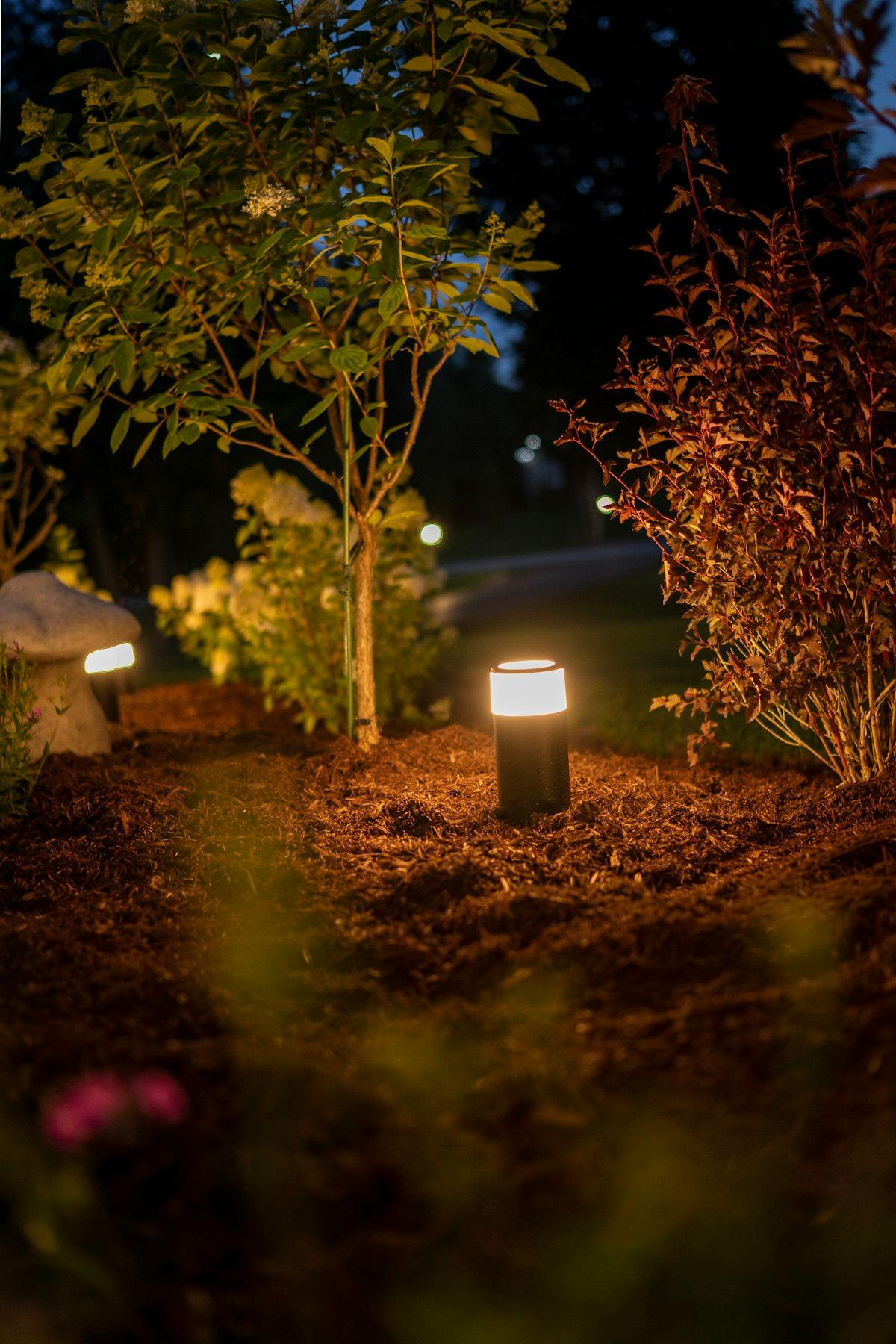
Low fixtures, spaced and staggered so the path reads as pools of light rather than a runway. Warm LEDs, shielded so you see the path and not the bulb.
Uplighting for trees and the house
Well lights and spotlights at the base of trees, columns and stonework, aimed to show the shape without glare into windows or the street.
Hardscape lights in walls and steps
Slim LED fixtures set under wall caps and into step risers, wired as the patio or retaining wall goes up, or retrofitted where the block allows.
Downlighting and moonlighting
Fixtures mounted high in trees or under eaves, aimed down through branches for soft, natural light over patios and lawns.
Decks, patios and outdoor living
Post-cap and rail lights, lighting for outdoor kitchens and pergolas, and the outlets and circuits those spaces need.
Transformer, circuit and controls
The 120-volt circuit, weatherproof outlet and transformer, plus an astronomical timer, photocell or Lutron control so the lights come on at dusk without you thinking about it.
How a landscape lighting job works
Designed by day, aimed at night.
- 1
We walk the property.
We look at what you want to light, where the transformer can live, where power already is, and whether a patio or wall project is coming that we should wire into.
- 2
You get a layout and a price.
Fixture locations, the controls you want, and the price before anything starts. If a landscaper or mason is involved, we coordinate with them.
- 3
We run the power and bury the cable.
The outdoor circuit and outlet go in first, with a permit where the county requires one. Low-voltage cable is buried to code and kept clear of future digging.
- 4
We aim it after dark.
Fixtures get set and aimed at night, when you can see the result. Then we set the timer or controls and show you how to adjust them.
Low voltage vs. line voltage
Which system for your yard?
Most residential landscape lighting is low voltage. Line voltage still has its place. Here's the difference.
Where it's used
- Low voltage (12V)
- Path lights, uplights, hardscape and deck lights: most of what a yard needs.
- Line voltage (120V)
- Floodlights, post lanterns, security lighting and anything that needs a lot of light.
How it's wired
- Low voltage (12V)
- A transformer on a GFCI outlet feeds direct-burial cable, usually 6 inches deep.
- Line voltage (120V)
- A full circuit in conduit or UF cable, buried deeper and permitted like any other circuit.
Safety
- Low voltage (12V)
- Low shock risk, and fixtures can be moved as plantings grow.
- Line voltage (120V)
- The same risk as any household circuit; GFCI protection and weatherproof fittings are required.
Design limits
- Low voltage (12V)
- Wire length and total wattage matter; long runs need heavier wire or a second transformer.
- Line voltage (120V)
- Fewer limits on distance, but every fixture is a fixed, permitted installation.
| Compared | Low voltage (12V) | Line voltage (120V) |
|---|---|---|
| Where it's used | Path lights, uplights, hardscape and deck lights: most of what a yard needs. | Floodlights, post lanterns, security lighting and anything that needs a lot of light. |
| How it's wired | A transformer on a GFCI outlet feeds direct-burial cable, usually 6 inches deep. | A full circuit in conduit or UF cable, buried deeper and permitted like any other circuit. |
| Safety | Low shock risk, and fixtures can be moved as plantings grow. | The same risk as any household circuit; GFCI protection and weatherproof fittings are required. |
| Design limits | Wire length and total wattage matter; long runs need heavier wire or a second transformer. | Fewer limits on distance, but every fixture is a fixed, permitted installation. |
The NEC sets 6 inches of cover for landscape lighting cable at 30 volts or less in UF or other identified cable, and keeps low-voltage lighting 10 feet from the edge of pools, spas and fountains unless the fixtures and transformer are listed for closer use. Sources are listed at the bottom of this page.
Google reviews
What our customers say.
“The team at Wyatt Electric is a lifesaver. I had a 70 year old GE low voltage lighting system that needed to be upgraded and couldn't find an electrician willing to tackle it. I called all of the big electrician companies and no one could help me. I came across Wyatt's name and reached out. They had some familiarity with the system and were willing to come out to take a look. They took the time to understand the system and help me figure out a solution using wireless switches. They had a quote to me within a couple of days and I was able to schedule the work within a week or two for a reasonable price. They showed up on time, were very friendly and professional and had the system fully converted within a couple of days. It took a lot of work to figure out the wiring as nothing was labeled correctly in the relay panel, but they figured it out. They labeled everything and the installation was very neat and clean. They programmed everything for me so that it was all ready to go. I can't say enough good things about how they treat their customers. They are my new electricians. I had them back to install under cabinet lighting and had the same great experience.”
“Wyatt Electric has handled several projects for me, and they've been excellent every time. They did the full electrical work for an addition on my home, redid my kitchen with modern LED strip lighting, installed heaters in my porch and added a panel and outlets in my garage. On every job they showed up when they said they would, finished within the timeframe they promised, and were friendly and professional throughout. The workmanship is high quality and clean, and I've been very satisfied with the results. It's rare to find a company that does what they say they're going to do and exceeds expectations. Wyatt Electric does both, and I highly recommend them.”
“They show up early and they work. They are professional, clean, and friendly. All my questions and concerns were addressed while they were on the worksite. Everyone that came to my property was friendly and did a great job. Would absolutely recommend and use them again.”
Landscape lighting questions
Before you book.
Can you add landscape lighting to an existing yard?
Yes. Low-voltage cable goes in a shallow trench or under mulch, so beds and lawns recover quickly. Hardscape lights are easiest to add while a wall or patio is being built, but many walls and steps can be retrofitted.
Why are some of my lights dimmer than others?
Voltage drop. On a long daisy-chained run, the last fixtures see less voltage than the first. Heavier wire, a hub layout or a multi-tap transformer fixes it, and that's what we design for up front.
Do I need a permit for landscape lighting?
The 120-volt outdoor outlet or circuit that feeds the transformer is permitted electrical work in Harford County, Baltimore County and Baltimore City, and we pull the permit. We'll tell you up front if your county wants anything for the low-voltage side.
Can my landscaper or mason install the lights?
Many do good work setting fixtures. The circuit, outlet and transformer connection should be done by a licensed electrician, and in Baltimore County only a registered electrical contractor can pull the permit. We're glad to work alongside your contractor.
Can the lights run on a schedule or from my phone?
Yes. The simplest is an astronomical timer or photocell at the transformer. If you have or want Lutron, a Caséta or RadioRA 3 outdoor plug is rated for low-voltage lighting transformers and brings the yard into the same app and schedules as the house.
Brass or aluminum fixtures?
Brass and copper cost more and last longer outdoors. Budget aluminum can pit and corrode within a few years. We'll show you both and tell you where it's worth spending.
Will it bother the neighbors?
It shouldn't. Good design means shielded fixtures aimed down or at the subject, a warm color temperature, and nothing pointed at windows or the street. Fewer, well-aimed fixtures beat a bright yard.
How do I get a price?
Book a visit online or call 410-557-8557. We walk the property with you, then give you a layout and the price before anything starts.
Where we work · Landscape & hardscape lighting
Three jurisdictions, one crew.
Each one has its own permit office and code edition. We work in all three and pull the permits ourselves.
- Harford CountyJarrettsville, Bel Air, Fallston, Forest Hill and the rest of the county.Electrician in Harford County
- Baltimore CountyTowson, Hunt Valley, Phoenix, Monkton, Sparks and the rest of the county.Electrician in Baltimore County
- Baltimore CityRowhomes and older houses across Baltimore City.Electrician in Baltimore City
Related services
Often paired with landscape lighting.
Sources
- NFPA 70: National Electrical Code (2020 and 2023 editions)
- Lutron support: Caséta Wireless Outdoor Smart Plug (PD-15OUT-BL) load types
- Harford County: permits, Permit Center and 2023 NEC adoption (Bill 24-06)
- Baltimore County Permits, Approvals and Inspections: electrical inspections
- Baltimore City Building, Fire and Related Codes, Part III (NEC 2020)
- Baltimore City DHCD: ePermits
Book a visit
Want the yard lit this season?
Let's design it.
Book online in about a minute, or call or text 410-557-8557, Monday–Friday, 7am–6pm. We confirm by text, and a licensed electrician shows up in your window.