Guide · Older panels
Federal Pacific Stab-Lok panels: what Maryland homeowners should do.
There has never been a recall. In 1983 the U.S. Consumer Product Safety Commission closed its investigation of Federal Pacific Electric (FPE) Stab-Lok circuit breakers without making a safety determination. If you have one, have a licensed electrician check its condition, then decide on facts rather than fear.
- ★5.0 · 12 Google reviews
- 4 Master Electricians on staff
- Licensed & insured
- Veteran owned
On this page
Federal Pacific Stab-Lok panels turn up in home inspection reports across Harford County, Baltimore County and Baltimore City, and the internet is full of strong opinions about them. This guide sticks to what the federal regulator actually said, what it didn't say, and how to decide whether to keep the panel or plan a panel replacement. We quote the Consumer Product Safety Commission (CPSC) directly where it matters, and the full release is linked at the bottom.
What the CPSC found in 1983
The CPSC spent about two years investigating FPE Stab-Lok residential circuit breakers and closed the investigation in 1983. The key points from its release:
- The trigger. In 1980, FPE reported that many of its breakers, mostly two-pole residential models made before Reliance Electric acquired FPE in 1979, didn't fully meet Underwriters Laboratories (UL) requirements.
- The testing. The Commission's own testing confirmed that those breakers failed certain UL calibration tests. Calibration tests check that a breaker carries its rated current and trips within set time limits when a circuit is overloaded.
- The disagreement. Reliance argued the failures posed no hazard in the home. CPSC staff said they had insufficient data to accept or refute that position.
- The decision. The Commission said the data available to it did not establish that the breakers pose a serious risk of injury to consumers. Getting the data needed to settle the question would have cost several million dollars, and the Commission chose not to spend that given its budget and other known hazards. It closed the matter without deciding whether the breakers are safe, and said it could reopen the investigation if new information warranted it.
Put plainly: the CPSC closed its investigation without making a safety determination, and there has never been a recall.
That's the whole federal record. It doesn't say the panels are safe, and it doesn't say they're dangerous. Anyone who tells you there was a recall, or that the CPSC declared them a fire hazard, is overstating it.
How to tell if you have one
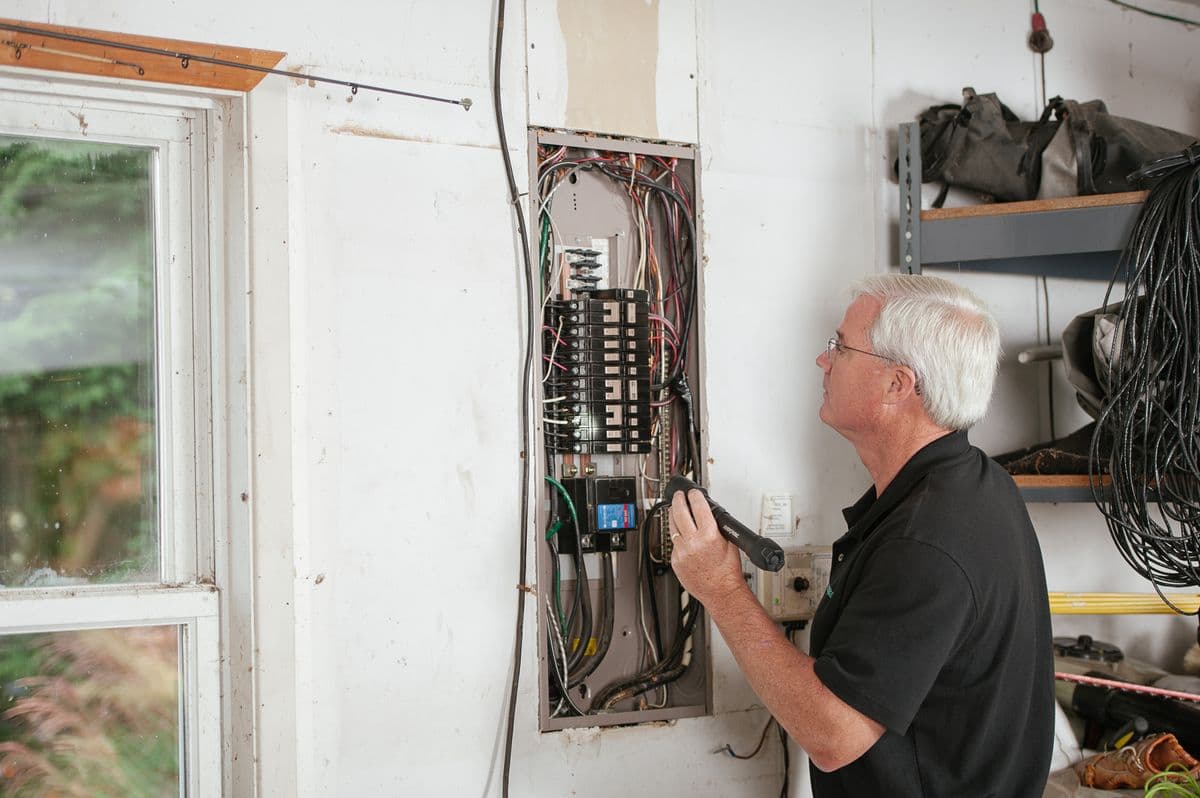
Look at the panel door and the label inside it without removing the inner cover. Signs include:
- “FPE” or “Federal Pacific Electric” on the cover or door
- “Stab-Lok” on the label inside the door
- Breakers with a red stripe across each handle
Don't take the dead-front cover off to look. There's exposed live metal behind it, and it's a job for a licensed electrician.
Your options
1. Have it looked at
Age, condition and how hard the panel is working matter more than the name on the door. An electrician can check for heat damage, loose or corroded connections, double-tapped breakers, missing knockouts and signs of overload, and tell you what they find in writing.
2. Keep it, and use it sensibly
The CPSC's 1983 release gave safety advice for every panel, not just FPE: know which outlets and appliances are on each circuit; don't overload circuits, especially with high-current appliances on low-amperage circuits; follow local codes when adding circuits; and find out why a breaker trips or a fuse blows rather than simply resetting or replacing it. When in doubt, it advised calling a licensed electrician.
3. Replace it
Many owners replace an FPE panel when there's another reason to open it up anyway: the panel is out of spaces, the house needs more capacity for an EV charger or heat pump, a buyer's inspector flagged it, or the panel is showing wear. A replacement is permitted and inspected new service equipment, built to the code edition in force where you live. See which electrical code applies in Maryland.
Selling or buying a house with an FPE panel
Home inspectors commonly note FPE panels in their reports. If you're the seller, a written evaluation or a permitted replacement gives the buyer something concrete. If you replace it, keep the paperwork: some municipal guidance notes that insurers may ask for proof that an older panel has been replaced.
What a replacement involves
- We confirm the panel brand and condition, and check what the house draws now and what you plan to add.
- We decide together whether you need a like-for-like panel or more capacity. If it's the latter, see upgrading from 100 to 200 amps.
- We pull the permit with your county or the city.
- The new panel goes in to code, every circuit is labeled, and we clean up.
- The inspector signs off.
Other older panel brands
Zinsco is the other name that comes up, and its story is different: there was no CPSC action, but municipal guidance describes known bus-bar connection problems. Our Zinsco panel replacement guide covers it.
Wyatt Electric has worked in homes across Harford County, Baltimore County and Baltimore City since 1986. If you've found an FPE panel, we'll look at it, tell you plainly what we see and give you a price before any work starts. No pressure either way.
Sources
- CPSC: Commission closes investigation of FPE circuit breakers and provides safety information for consumers (1983)
- City of Lawndale, CA: electrical panel guidance (Zinsco and Federal Pacific)
- Harford County: Permits and the Permit Center
- Baltimore County Permits, Approvals and Inspections: electrical inspections
- Baltimore City DHCD: ePermits
FPE questions
Quick answers.
Were Federal Pacific Stab-Lok panels recalled?
No. The CPSC closed its investigation in 1983 without making a safety determination, and there has never been a recall.
Did the CPSC say FPE breakers are dangerous?
No. It confirmed some breakers failed certain UL calibration tests, but said the data available did not establish a serious risk of injury, and closed the matter without deciding whether they are safe.
Do I have to replace my FPE panel?
No law requires it. Have a licensed electrician check its condition. Many owners replace it when they need more capacity, are selling, or the panel shows wear.
Can you just replace the breakers?
We'll talk through options after we see the panel's condition. In most cases where the panel itself is worn or out of spaces, replacing the panel is the cleaner fix.
Keep reading
Keep reading.
- Panel & service upgradesReplacing old or full panels and upgrading service, permitted and inspected.
- Zinsco panel replacementHow to spot one, the known bus-bar problems, and how a replacement is permitted and done.
- Upgrading from 100 to 200 ampsWhen 100-amp service stops being enough, and what a 200-amp upgrade involves.
- Which electrical code applies to my home?The 2023 and 2020 NEC editions, and which one your county or the city enforces.
Panel and service upgrades
Questions about your panel?
We'll come look at it.
Book a visit and one of our licensed electricians will look at your panel and service, explain what we find, and give you a price before any work starts. Or call or text 410-557-8557, Monday–Friday, 7am–6pm.
Burning smell, sparking or no power? Don't book online. Call now: 410-557-8557